Twarit Industries recently conducted a detailed technical presentation on BARC-developed Drinking Water Purification and Wastewater Treatment Plant technologies at the Haryana State Pollution Control Board (HSPCB). The session marked an important step towards promoting advanced, indigenous, and sustainable water management solutions aligned with regulatory and environmental objectives.
The presentation was attended by senior officials, engineers, and technical experts from HSPCB. Twarit Industries showcased scientifically proven technologies developed by Bhabha Atomic Research Centre (BARC), emphasizing their practical implementation for municipal, industrial, and institutional applications across Haryana and other regions.
Technical Engagement with HSPCB
The session focused on demonstrating how BARC-backed technologies can help industries and urban bodies meet CPCB and State Pollution Control Board norms while ensuring long-term operational stability. Detailed discussions were held on influent variability, treatment efficiency, compliance parameters, and treated water reuse potential.
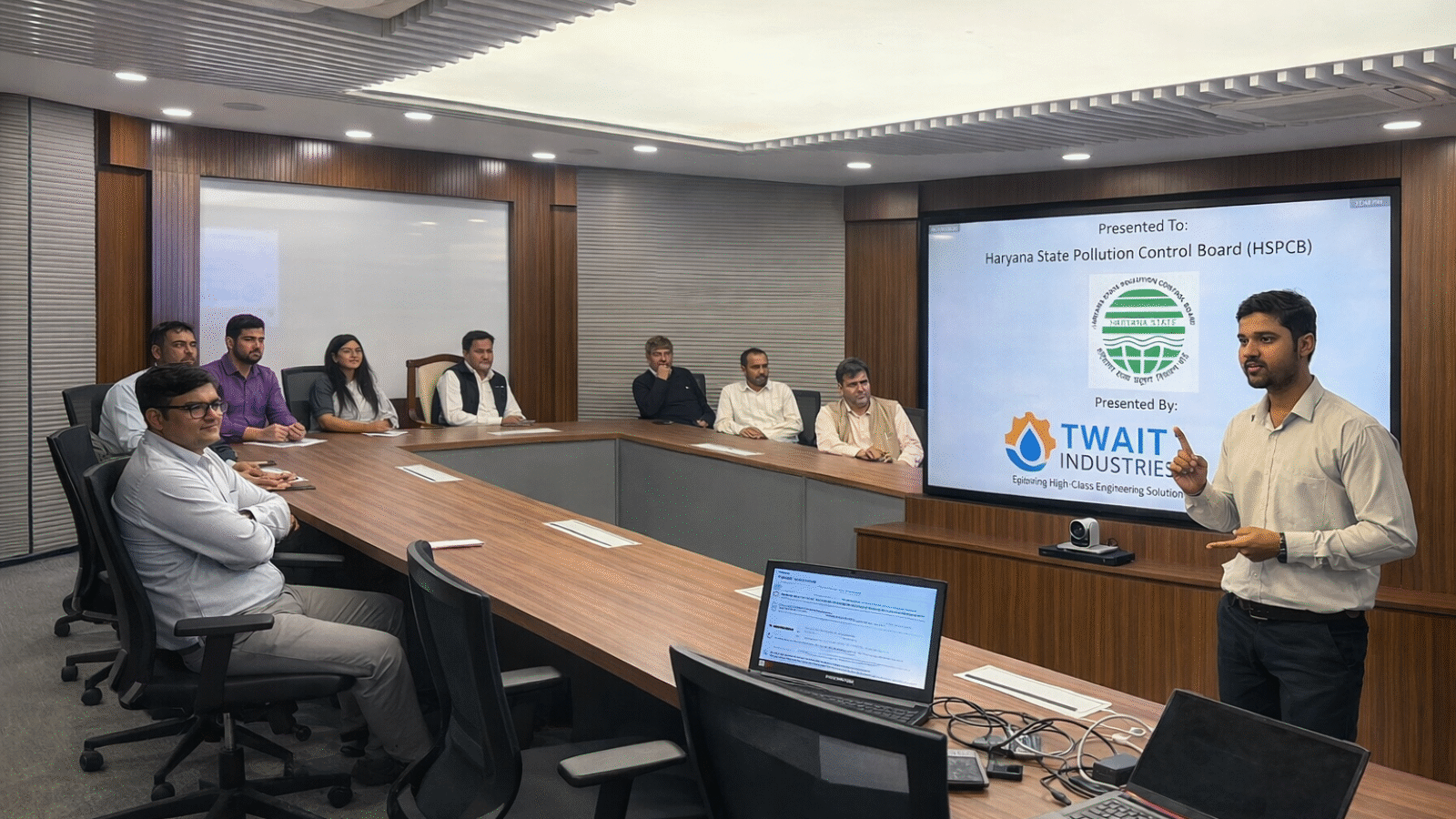
The interaction provided an opportunity to address real-world challenges faced by regulatory authorities, such as rising wastewater loads, limited land availability, and the need for cost-effective yet reliable treatment systems. The image from the event captures the live presentation and technical dialogue between Twarit Industries and HSPCB officials.
Drinking Water Purification Solutions
A major highlight of the presentation was the BARC-based Drinking Water Purification Technology, designed to effectively remove physical, chemical, and biological contaminants. These systems are capable of treating water with varying raw quality, including groundwater and surface water sources affected by turbidity, salinity, and dissolved impurities.
The technology ensures consistent potable water quality, reduced chemical usage, and optimized operational costs. Its modular design allows easy integration for urban supply schemes, rural drinking water projects, and industrial water requirements.
Advanced Wastewater Treatment Plant Technologies
Twarit Industries also presented advanced Wastewater and Sewage Treatment Plant (STP/ETP) solutions incorporating BARC-supported biological treatment processes. These technologies are designed for high organic load handling, stable performance under fluctuating flow conditions, and compact plant layouts with minimal footprint.
The systems offer improved sludge settleability, enhanced treatment efficiency, and suitability for water reuse applications such as gardening, flushing, and industrial process reuse. Such solutions play a critical role in achieving sustainable wastewater management and zero liquid discharge (ZLD) objectives.
Commitment to Sustainable and Indigenous Technologies
Through this presentation at HSPCB, Twarit Industries reinforced its commitment to promoting indigenous, research-backed technologies that support India’s environmental and water security goals. The company emphasized its role as a technology integrator, providing complete solutions from design and engineering to installation, commissioning, and operation & maintenance.
About Twarit Industries
Twarit Industries is a leading provider of Drinking Water Treatment Plants, Wastewater and Sewage Treatment Plants, and advanced BARC-based treatment solutions. With a strong focus on regulatory compliance, innovation, and sustainability, the company continues to collaborate with government bodies, research institutions, and industries across India to deliver efficient and future-ready water infrastructure.